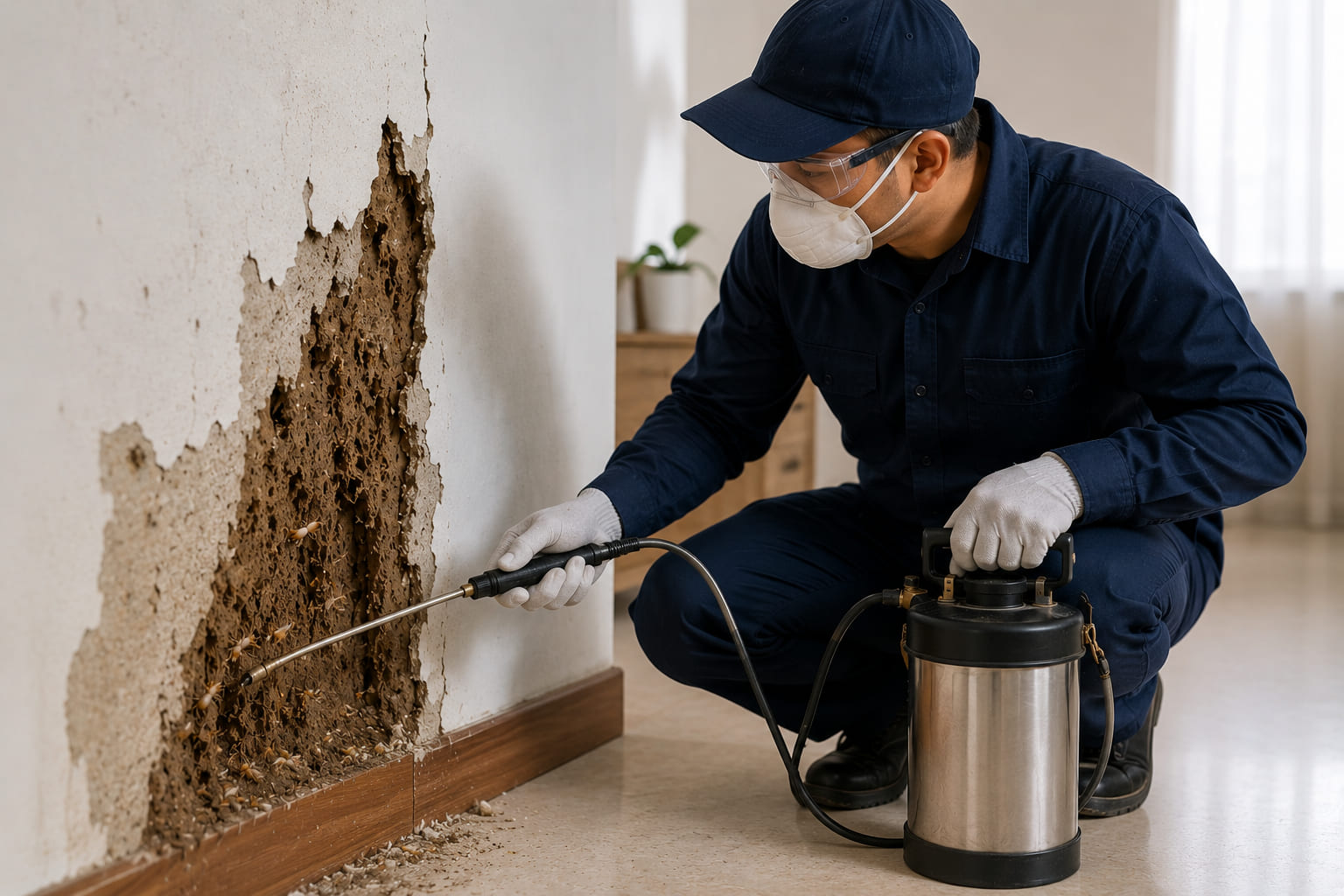
Termites work in silence.
They eat through your walls every day. You cannot hear them. You cannot see them. But the damage they leave behind is very real — and very expensive.
By the time most people notice, termites have already been inside for months. Catching them early can save you lakhs in repairs. Here is what you need to know.
Why walls are a prime target
Termites love dark, damp, undisturbed spaces.
Your walls give them exactly that. They tunnel through wooden frames, door borders, skirting boards, and window edges. Termites eating wood in the walls hollow it from the inside out. The outside looks perfectly fine. Inside, it is empty.
This is what makes them so dangerous. The damage is hidden until it is serious.
Signs of termites in walls
Your walls will give you clues. Here is what to look for:
Hollow sound when you tap
Knock on your wall. Does it sound empty? Termites eat the inside. The outer surface stays. The hollow thud is one of the clearest signs of termites in walls.
Mud tubes along the wall
Subterranean termites build narrow mud tunnels. You will spot them near the base of the walls or corners. These pencil-thin tubes are highways for termites. Never ignore them.
Paint bubbling or peeling
Termites produce moisture as they work. This moisture builds up under the paint. The paint starts to bubble, blister, or peel. Many people blame humidity. Often, it is termites.
Frass near walls
Drywood termites push their droppings out. These look like tiny wood pellets or fine sawdust. Finding frass near skirting boards or below walls is a strong warning sign.
Tightly shut doors and windows
Have your doors become hard to open? Termites eat into wooden structures. The heat generated by tunnels causes wood to expand. Tightly shut doors are one silent indication.
Wings left outside windows
When termites swarm, they shed their wings. Discovery of such wings outside window sills suggests that there is a termite colony nearby.
Cracks in wood paneling
Unexplained cracks in wood along your walls are a red flag. Termites eating wood in walls create internal weakness. The wood warps, cracks, and sags over time.
Tapping or rustling noises
Go into an empty room and put your ear to the wall. The soldier termites thump their heads to signal a warning. Listen for any slight tap or rustle. Any unusual wall sounds should be taken seriously.
How much damage can termites cause?
Too much. Too soon.
One termite colony may consist of several million members. They operate around the clock without taking any breaks. They can cause substantial damage to wall frames in just one year. The structural beams will weaken. Your ceilings might droop. Under extreme circumstances, walls become too weak to support anyone standing against them.
The longer you wait, the higher the cost.
Termite in wall treatment options
Treatment depends on the termite type and the extent of the damage.
Liquid termiticide injection
Professionals drill small holes into the wall. They inject a chemical termiticide directly into the colony zones. The chemical spreads through the tunnels. It kills termites on contact and keeps working for years. This is one of the most effective termite-in-the-wall treatments available.
Foam application
The termiticide is injected into wall cavities and hollow areas. The foam will expand to cover every crevice. Foam can reach areas where liquid termiticides cannot penetrate. Foam application is recommended for walls with complicated interiors.
Bait stations
This type involves placing bait stations near your property. Termites will bring the bait back to their nest and eventually destroy the entire nest. The process requires some time to see effects. However, it is deep-acting and uses minimal pesticides indoors.
Heat treatment
In this case, heat is applied to the parts of the wall affected by termites. Termites cannot stand high temperatures. Heat treatment does not involve any chemical application.
Termite damage repair — what comes after treatment
Killing termites is only half the job.
Once the infestation is gone, the damage still needs to be fixed. Here is how termite damage repair is typically handled:
- Minor damage — wood hardeners and fillers are used. They seal and strengthen the hollowed wood. This works for surface-level damage.
- Moderate damage — damaged sections of wood are cut out. New wood is fitted and sealed. The wall is then replastered or repainted.
- Severe structural damage — load-bearing beams or wall frames may need full replacement. A structural inspection is essential before repairs begin.
Always treat first. Repair after. Repairing before treatment is a waste of money.
How to prevent termites from coming back
- Fix water leaks around walls immediately
- Keep wood — furniture, firewood — away from walls
- Ensure good ventilation to reduce moisture
- Schedule a professional inspection every year
- Use termite-resistant wood for any new construction
Spot the signs? Do not wait.
Termites do not slow down on their own. The sooner you act, the less damage they do. Get professional help from a trusted Termite Control in Kolkata team at EcoPulse India — and protect your home before the damage grows.
Termites are not dramatic. They are patient.
They move slowly. They hide well. But every day they are inside your walls, the damage grows. Hollow sounds, mud tubes, peeling paint — these are not small problems. They are warnings.